
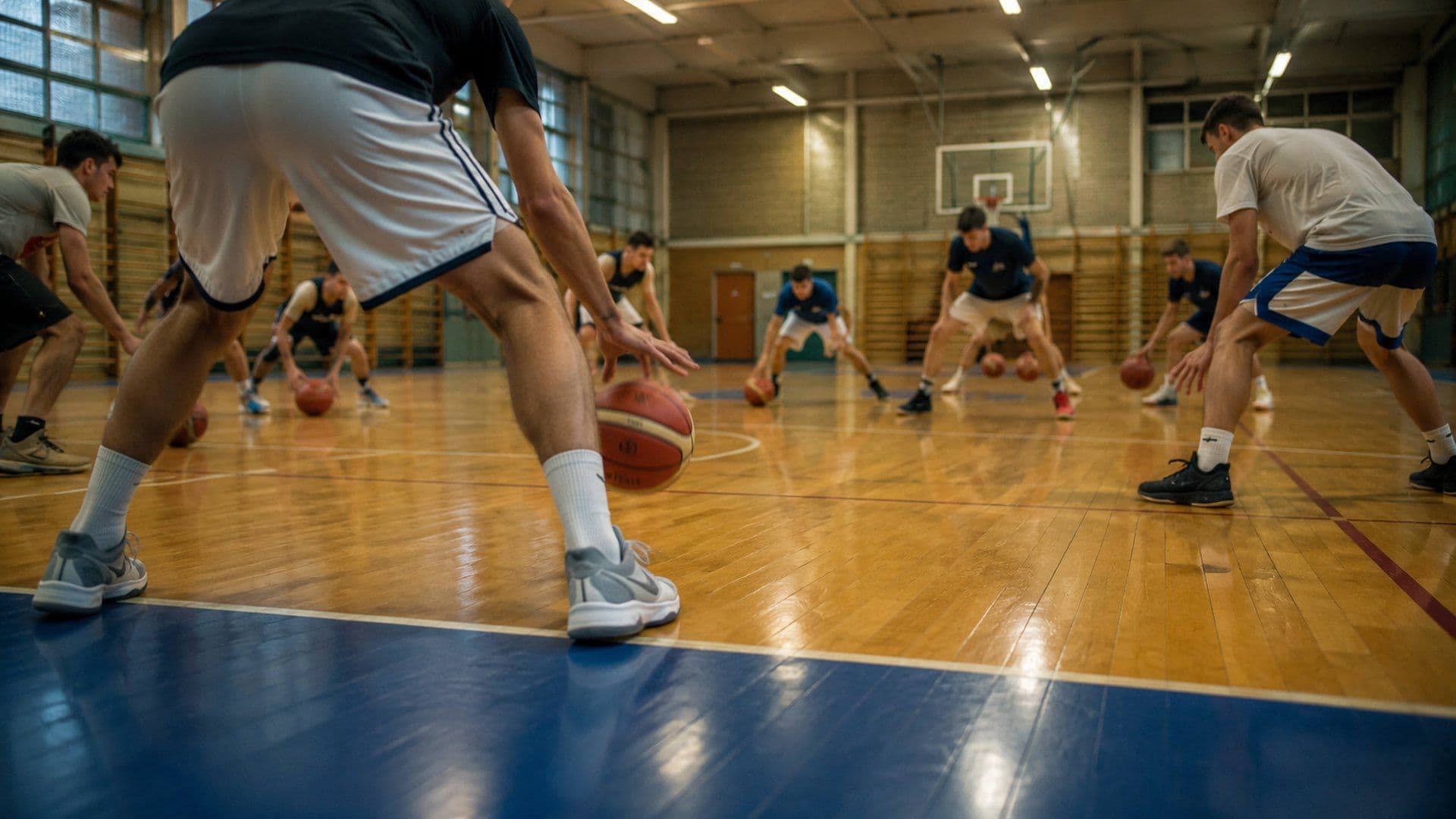
Basketball warm-up games: four that actually warm a team up
Two laps of the hall and a static hamstring stretch. It is the most copied ten minutes in British basketball and almost nobody has looked at it since they inherited it.
Two laps of the hall and a static hamstring stretch.
It is the most copied ten minutes in British basketball, inherited from a coach who inherited it from somebody else, and it survives because nothing obviously bad happens afterwards. But those are the only minutes of the whole session in which everybody is fresh, nobody has lost a ball yet and every head is up. The warm-up is not the toll you pay before training. It is the first thing you train.
Three things at once, or it is just running
Temperature, ball contact and attention. Anyone gets the first two by sending the squad up and down with a ball in their hands. The third is the one that separates a warm-up from a jog, and there is only one way to raise it: force a choice. Two options, a defender, a clock — the mechanism does not matter, the decision does.
If ten minutes have gone by and nobody has had to choose between two things, you did not warm the team up. You made them sweat.
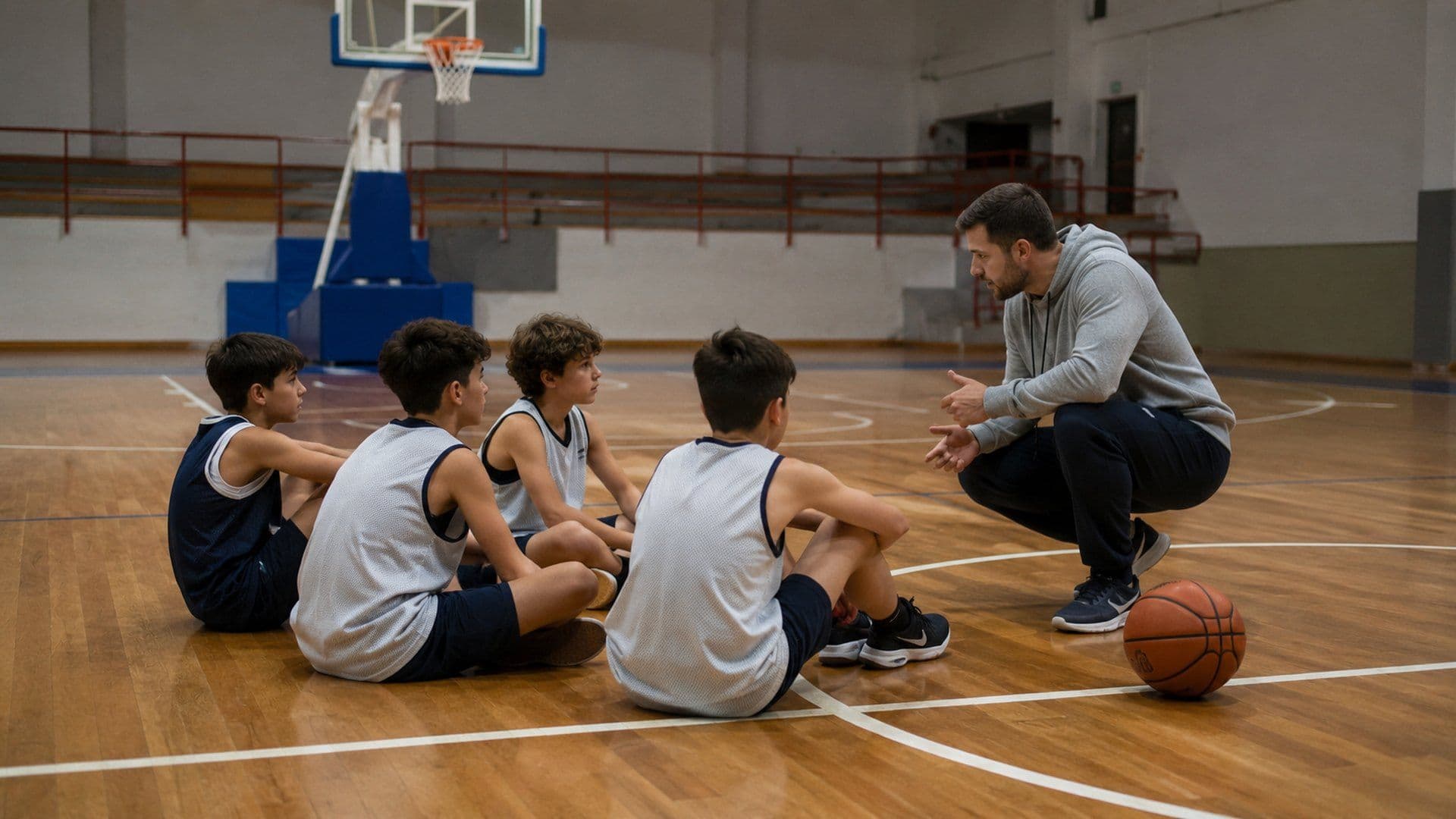
⚠️ Forcing a choice is not the same as coaching one. Mistakes in the warm-up are free: no technical corrections, no long stoppages. The moment you start explaining, you have lost the ten minutes you were trying to protect. The corrections belong in the block that follows, where they have a criterion attached to them.
Four games
| Game | How it runs | What it raises |
|---|---|---|
| Bulldog with a ball | Everyone dribbles from baseline to baseline; two catchers try to knock the ball away without grabbing. Caught players become catchers | Heart rate, protected dribble, eyes up under pressure |
| Knee tag | In pairs inside a small square, thirty seconds, touch your partner's knee without being touched yourself | Feet, hips, reaction, legal contact |
| Keep-ball, no dribble | 4v4 in half a court, ten consecutive passes is a point, picking the ball up ends it | Movement off the ball, reading the defender, breathing |
| End to end against the clock | Three-lane break with no defence over the full 28 metres; the group must complete six lengths inside two minutes | Running wide, passing on the move, tempo |
🔑 Keep-ball is the one to keep if you only have room for one. Banning the dribble forces every player to move without the ball, and in four minutes it delivers running, defence and vision at the same time — which is more than most drills manage in twelve.
The running order matters more than the games
Start with something nobody can lose: bulldog or knee tag. Real competition — keep-ball with a scoreline, or anything ending at a basket — goes last, when bodies are ready and a hard landing is survivable. Open with the competitive game instead and you get your first rolled ankle at minute two, on cold joints, and the rest of the evening is spent with ice.
End to end against the clock works well as a hinge. It lifts the tempo without contact and leaves the squad already on their feet for the first block, so the session begins standing up rather than sitting in a circle.
And the stretching?
Static, cold, before running: no. It is the worst possible moment for it and it prepares nobody for anything that happens in the following hour. Moving mobility — lunges, hip openers, heel flicks on the walk back to the baseline — belongs inside the first game, not in front of it. Long static stretching, if you want it at all, goes at the end of the session or at home.
The minutes change with the age group
| Age group | Length | How to set it up |
|---|---|---|
| U12 | 12–15 minutes | Pure play, always with a ball; no instruction beyond the rules of the game |
| U14 | 12 minutes | Two games, one technical and one competitive; a scoreline can be introduced here |
| U16 | 10 minutes | Three short games, quick changeovers; mobility folded into the first one |
| U18 | 8–10 minutes | Shorter and sharper, legal contact from the second game onwards |
In the youngest groups the warm-up can happily be the best part of the evening. At U18 it should not be: what you need at minute nine is a squad ready to play at match tempo, not a squad that enjoyed itself.
How you know it worked
- The breathing — at the end they answer in short sentences. Comfortable conversation means the intensity was not there.
- The first block — if it starts without you having to call anyone in twice, the warm-up did the mental work as well as the physical.
- The hands — anyone who touched a ball roughly every ten seconds arrives ready. Anyone who stood in a queue does not.
Ten minutes in which you should barely speak
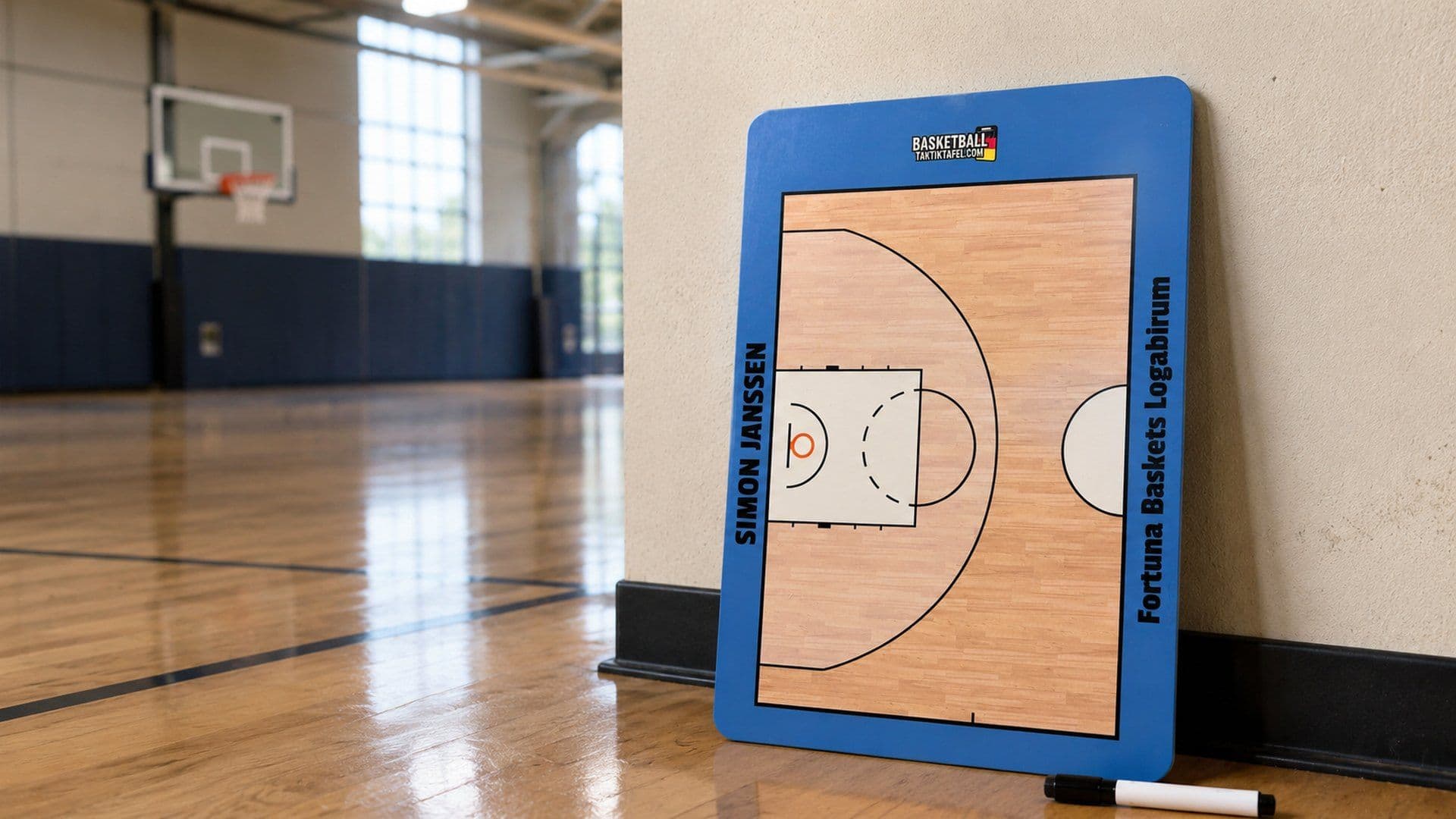
Here is the paradox: the warm-up is the phase where coaches talk most and players need them least. Put the whole thing on your coaching board — the four games, the minutes beside each, the pairs already written — and stand it where they come onto the court. Nobody gets gathered in. At the end of each game they glance, they move, and the changeover costs you five seconds instead of ninety.
Which frees you to do the only thing worth doing in those ten minutes: watching ankles, faces and who is limping before they tell you. If you want the same board working in the moments where it matters most — the time-out, the last two minutes — there is a separate guide to using one well.
Design your own coaching board
Over 10,000 coaches have already created theirs.
You might also like
Liked this article?
Design your fully personalised coaching board with your name, club colours and team identity.
Design now →