Basketball set plays: four throw-ins worth practising
Four seconds left, one point down, and the ball is yours under your own basket. This is the only situation all season in which every player starts still and you get to choose what happens next.
Four seconds left, one point down, and the ball is yours under your own basket.
Everybody in the hall knows what is coming, including the eleven-year-old on the far bench. And yet most teams will get this wrong, not because the play was bad but because it was chosen on the way to the baseline. A throw-in is the only situation all season in which every player starts still, the clock is stopped and you get to decide what happens next.
Which makes it the cheapest source of points a squad has, and the one that gets the least floor time in training.
Two rules shape every throw-in you will ever draw
The thrower has five seconds. That is the whole clock, and it starts when the ball is placed at their disposal — not when they are ready. Any play that needs three separate reads will die inside it.
And the thrower's feet are restricted: from a designated out-of-bounds spot they may move no more than a metre to either side, though they can go as far backwards as the hall allows. The exception is the one everyone forgets — after a made basket, the throw-in comes from anywhere behind the end line, the thrower can run along it, and a teammate can take the ball there too. That single difference is worth a full-court press escape all by itself.
Choose the play before you cross the line, not after. A team that hears the call while walking to the baseline has already used two of its five seconds.
Four worth practising
| Play | How it runs | When to call it |
|---|---|---|
| Box (baseline) | Two at the elbows, two on the blocks. On the slap, the ball-side block screens across for the far low player, who cuts to the front of the rim; the screener steps back to the ball as the second option | Default baseline play. Works against man-to-man and survives a switch |
| Stack (baseline) | Four in a line down the lane facing the thrower. On the slap the front two split to the corners, the third cuts hard to the rim, the fourth pops out to the top as safety | Against a squad that has just switched to zone, or when your best shooter needs a clean corner |
| Line (sideline) | Four across the free-throw line extended. The two nearest the ball cut in opposite directions, the far two exchange; the last one out becomes the reversal | Sideline in the frontcourt with more than eight seconds left |
| Get-in (either) | Two deep, two short, nobody scores. The single job is a safe catch and an immediate reversal away from pressure | Under pressure, late in a match you are leading, or any U12 or U14 side |
🔑 Get-in is the one every squad needs and almost nobody practises. Most throw-ins lost in junior basketball are not lost because the clever play failed — they are lost because there was no unclever play to fall back on.
Three things that kill a good play
- The thrower watching the play — they should be watching the defence. The cut that comes open is rarely the first one drawn, and only the thrower can see which defender turned their head.
- Screening too early — the screen has to arrive after the defender has committed, which means the second cutter waits. It is the same timing rule that governs everything in open play, and it fails here more visibly.
- No exit — every play needs a player moving away from the ball at second three. Without one, the five-second call is a formality.
What to have ready, by age group
| Age group | How many plays | The aim |
|---|---|---|
| U12 | One | Get-in only. Success is a clean catch in the backcourt, not a basket |
| U14 | Two | Box plus Get-in. Both practised from both sides of the floor |
| U16 | Three | Add Line for sidelines. Introduce reading man-to-man versus zone before calling |
| U18 | Four, plus one special | A dedicated play for under five seconds, practised at the end of sessions when legs are tired |
⚠️ More plays is not better. A squad with four plays it can run at speed beats a squad with nine it half-remembers, every time. If you cannot run it in training without a diagram in front of you in November, it will not exist in February.
Put the board in the thrower's hands
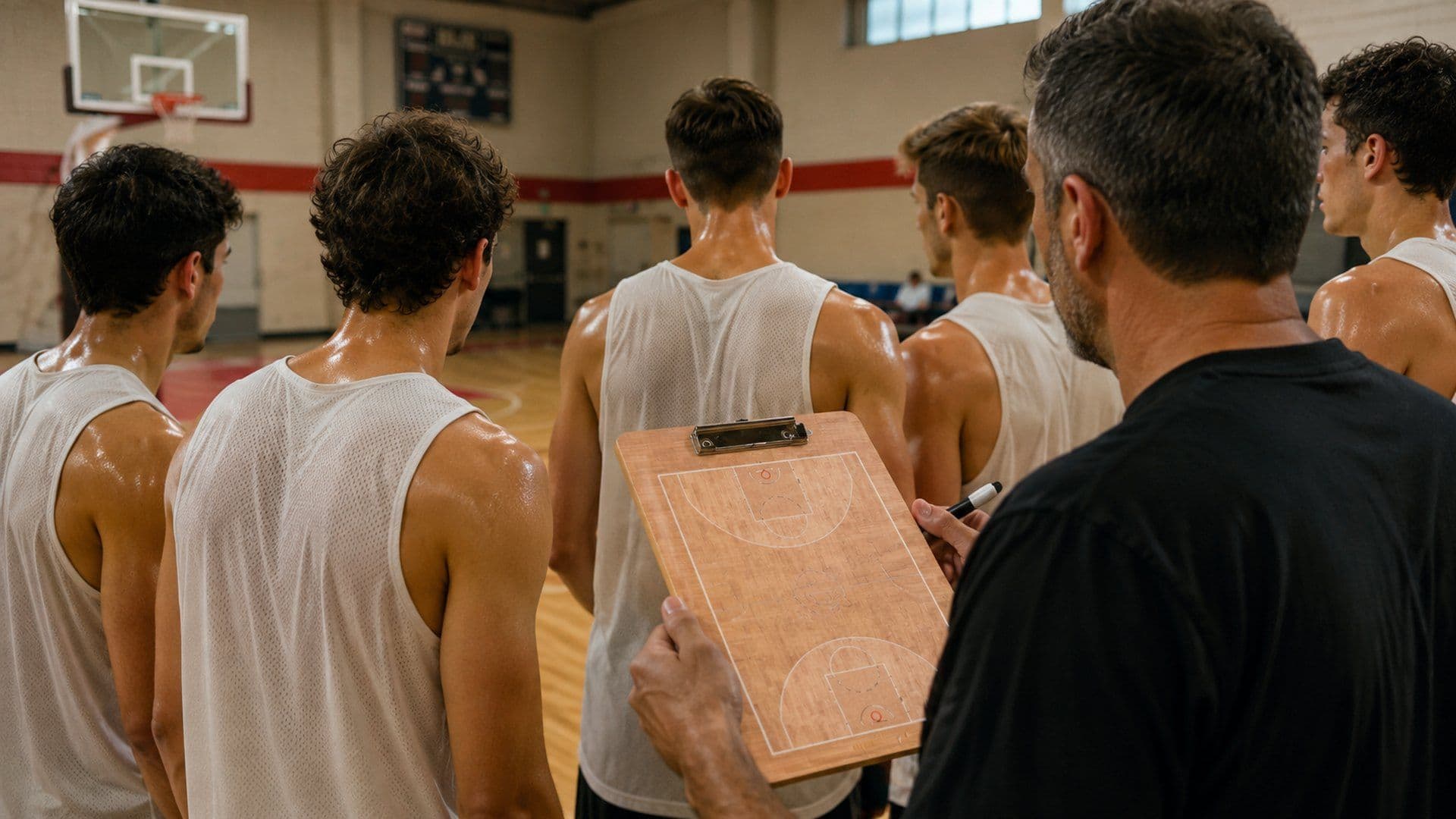
There is one detail worth changing this weekend, and it costs nothing. In the huddle, do not hold the coaching board up in front of the group. Draw the play and hand it to the player taking the throw-in — the one person on the floor who will have their back to everything and only five seconds to read it.
They hold it, they trace the first cut with a finger, they give it back. Then wipe it and draw the counter for the same play, because the one you called in the first quarter will be jumped in the fourth, and a board you can redraw forty times in one match is the difference between having plays and having a folder of them.
The season's worth of plays lives in your head; the discipline for using the board in a one-minute time-out is a separate skill, covered in the guide to using a coaching board well.
Design your own coaching board
Over 10,000 coaches have already created theirs.
You might also like
Liked this article?
Design your fully personalised coaching board with your name, club colours and team identity.
Design now →